“Seek opportunities to show you care. The smallest gestures often make the biggest difference.”
John Wooden

Tuesday, November 4, 2014

Learning to Play Outside the Box

By Karch Kiraly
I’ve often said that forearm passing is the cornerstone of volleyball, and I believe it more than ever now that I’m a coach. If you want to elevate the play of those around you, indoors or beach, you have to be able to make the ball go where you want by using your forearm platform.
When you think about it, every player on the court is required to pass. In the indoor game, even middle blockers have to set a hittable ball when a dig sprays their way – either overhead or with their platform. They also have to pass free balls, down balls, short serves or those that dribble over the net, and they have to cover their outside hitters when they get blocked.
The U.S. Women’s National Team faces these situations in every practice and every match. With such a fine margin between winning and losing, any one of these plays can determine the outcome. And, of course, beach players face the same thin margins and the same demands to make the ball go where they want.
During a game, players almost always have to receive a ball from one direction and make it go another – that is, they have to make an angle with their platform. There are very few game opportunities where you play a ball right back to where it came from, though that’s exactly what we do in partner activities like traditional pepper. If you can’t find a partner, a better way to practice making angles is to stand in the corner of two walls and repeatedly hit a spot on one wall, then the other. But even that drill has its flaws because the objective of a passer is to make the ball go to a teammate, not the next spot on the wall.
I prefer it when a player practices with two other people – friends, parents, siblings, anybody who’s willing. One person tosses or serves a ball over a net-high rope, and another is a catching target a few feet away from the “net.” (This is a drill you can do in the backyard or any place you can tie a rope.) This drill makes the passer take serves from various places around the court and pass them to a target.
Of course, the best way to practice – spoiler alert here – is to play this game called volleyball: doubles or with three players, indoors, on grass, on sand, wherever you can find a net.
Read the rest of the article by clicking on the link below:

Sunday, October 26, 2014

Broughton coach has helped build 2 strong volleyball programs in Raleigh

cgrant@newsobserver.comOctober 23, 2014 


 — When Jim Freeman took over the Cardinal Gibbons volleyball program in 1991, he knew next to nothing about the sport.
A sudden coaching vacancy forced the then-Gibbons assistant athletics director and former baseball coach to step in and learn on the fly.
“I coached in a state of panic,” said Freeman, now the head volleyball coach at Broughton High School in Raleigh. “I brought people in who did know what was happening. I didn’t have an ego about it. I tried to learn as much as I could, but I was always trying to find great assistants.”
Today, with 23 years of experience under his belt, Freeman is one of North Carolina’s most successful high school volleyball coaches. He led Cardinal Gibbons to 12 state championships while compiling a 426-117 record with the Crusaders. He has also coached at Friendship Christian and St. Mary’s, leading the latter to its first NCISAA state tournament appearance in school history.
Freeman has also found success at Broughton since he was hired last spring. The team earned the No. 1 seed for the East region in this year’s NCHSAA 4A volleyball tournament.
Meanwhile, Cardinal Gibbons is still going strong since Freeman left the program in 2010. The school’s volleyball team is the No. 2 seed in the 3A tournament, and it has won the past five NCHSAA titles in its division.
Freeman’s philosophy remains to surround himself with strong coaches, which is evident in his handling of an emerging Broughton program. During a second-round playoff game against Leesville Road on Tuesday, Freeman made sure he was heard when the team needed it, but a good amount of the in-game talking came from assistant coach Traci Smith.
“It’s an interesting dynamic that I think you probably don’t have in a lot of programs,” said Smith, who was the head coach of the Capitals for two seasons and led the team to last year’s Cap Eight conference title.
Smith, a former player and coach at Appalachian State, knew the time commitment needed to build a strong high school program. Just two years before that conference title, Broughton volleyball won only three games.
Read the rest of the article by clicking on the link below:

Wednesday, October 22, 2014

The Race to Nowhere in Youth Sports


By John O'Sullivan
http://changingthegameproject.com/


“My 4th grader tried to play basketball and soccer last year,” a mom recently told me as we sat around the dinner table after one of my speaking engagements. “It was a nightmare. My son kept getting yelled at by both coaches as we left one game early to race to a game in the other sport. He hated it.”
“I know,” said another. “My 10 year old daughter’s soccer coach told her she had to pick one sport, and start doing additional private training on the side, or he would give away her spot on the team.”
So goes the all too common narrative for American youth these days, an adult driven, hyper competitive race to the top in both academics and athletics that serves the needs of the adults, but rarely the kids. As movies such as “The Race to Nowhere” and recent articles such as this one from the Washington Post point out, while the race has a few winners, the course is littered with the scarred psyches of its participants. We have a generation of children that have been pushed to achieve parental dreams instead of their own, and prodded to do more, more, more and better, better, better. The pressure and anxiety is stealing one thing our kids will never get back; their childhood.
The movie and article mentioned above, as well as the book The Overachievers: The Secret Lives of Driven Kids, highlight the dangerous path we have led our children down in academics. We are leading them down a similar path in sports as well.
As I said to my wife recently, the hardest thing about raising two kids these days, when it comes to sports, is that the vast majority of the parents are leading their kids down the wrong path, but not intentionally or because they want to harm their kids. They love their kids, but the social pressure to follow that path is incredible. Even though my wife and I were collegiate athletes, and I spend everyday reading the research, and studying the latest science on the subject, the pressure is immense. The social pressure is like having a conversation with a pathological liar; he is so good at lying that even when you know the truth, you start to doubt it.  Yet that is the sport path many parents are following.
The reason? FEAR!
We are so scared that if we do not have our child specialize, if we do not get the extra coaching, or give up our entire family life for youth sports, our child will get left behind. Even though nearly every single parent I speak to tells me that in their gut they have this feeling that running their child ragged is not helpful, they do not see an alternative. Another kid will take his place.  He won’t get to play for the best coach. “I know he wants to go on the family camping trip,” they say, “but he will just have to miss it again, or the other kids will get ahead of him.”
Read the entire article by clicking on the link below:

Thursday, September 25, 2014

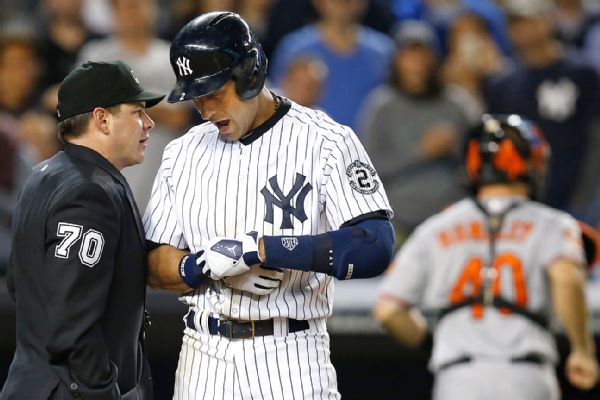
Jeter pitched perfect game with umps


Blues make call on Captain's career after 2,902 straight games without an ejection


September 25, 2014


NEW YORK -- Derek Jeter will receive his ultimate lifetime achievement award at some point Thursday night, whenever Joe Girardi decides to remove him from the game and turn him over to the full house. The fans will cheer and cry and do whatever moves them to celebrate the 40-year-old New York Yankees captain, and then Jeter will leave the Bronx as an active player for the last time.
He will leave with all kinds of trophies and milestones zipped inside his travel bag, and one that shouldn't be lost under the pile. His only perfect record. Barring the sudden emergence of a hot-headed umpire fixing to break Twitter for good, Jeter will exit Yankee Stadium having played 2,903 major league games, postseason included, without earning a single ejection.
Yes, the adults in the stands have dressed their kids in jersey No. 2 because of the five championships, the 3,461 hits, and the commitment to approaching every game the way Joe DiMaggio did -- as if someone out there was watching him play for the very first time. But the respect Jeter forever showed the game's authority figures at a time when that respect on ballfields across America -- from Little League to the pros -- was an oft-ignored suggestion, not a mandate, represented a core piece of his mass appeal.
In more than 20 years Jeter never once lost it with an umpire, a remarkable feat considering how verbal abuse of umps has long been accepted as part of the game, just like Cracker Jack, ballpark franks, and the seventh-inning stretch. Not just accepted, but encouraged. Glorified, even.
People used to laugh at the expression, "Kill the ump," and let's face it: Who hasn't appreciated the bygone images of a raging Billy Martin or Earl Weaver or Lou Piniella going nose to nose with an umpire while kicking dirt on his shoes?
But the prototypical ill-tempered manager expected to defend his team has hardly been the lone offender. Babe Ruth once punched an umpire in the head, and Roberto Alomar once spat in an umpire's face. Even mild-mannered, ump-friendly stars have a history of blowing a gasket here or there.
Cal Ripken Jr. was ejected three times, Tony Gwynn twice. Lou Gehrig was ejected for cursing out Ty Cobb. Rod Carew was 10 years into his career before he got tossed from a game; he responded by hurling bats onto the field and throwing a ball in the direction of the ump. Wade Boggs was in his 17th season, a week away from his 40th birthday, when he finally earned an ejection for arguing balls and strikes.
[+] EnlargeDerek Jeter
AP Photo/Kathy WillensDerek Jeter's respect for the umps ran deep during his 20-year career, even in times of disagreement.
Even while playing in the most volatile market, and spending most of his prime under a suffocating boss, George Steinbrenner, Derek Jeter never had his bad hair day. Tuesday night, after he was called out on strikes in the fifth by D.J. Reyburn (the ball appeared to be a tad outside), the shortstop did what he always does when he believes the guy behind the plate missed it on strike three.
Jeter lowered his head as he stepped toward the ump in a non-threatening way, containing the discussion as much as possible so the man behind the mask didn't feel he was being embarrassed. The captain said what he needed to say and quickly exited before mouthing the word, "Wow."
Umpires who regularly confront a lack of civility have cherished the Jeter way for two decades. Major League Baseball is always reluctant to allow active umps to comment publicly on the pros and cons of an active player, even a legendary one with less than a week left in his career, but five retired umps who worked some of Jeter's games, who have watched many more from afar, and who have a combined 126 years of big league experience were free to weigh the impact of the shortstop's professionalism on their craft.
They'd all dealt with the high-stakes madness of the postseason, where participants are more likely to go to Defcon 1. Richie Garcia was stationed in right field for Game 1 of the 1996 American League Championship Series when 12-year-old Jeffrey Maier reached over the wall -- Garcia never saw him -- and deflected Jeter's fly ball away from Baltimore's Tony Tarasco and into history; Garcia also called Mark Langston's 2-2 pitch to Tino Martinez a ball right before Martinez hit a grand slam in the 1998 World Series. Randy Marsh was the first-base ump who initially ruled Alex Rodriguez safe on A-Rod's infamous slap play against Boston in Game 6 of the 2004 ALCS before the crew convened, correctly called A-Rod out, and ordered Jeter to return to first base.
Don Denkinger was responsible for the most conspicuous blown call in World Series history in 1985, when he ruled Kansas City's Jorge Orta safe in the ninth inning of a Game 6 the Royals would rally to win before routing St. Louis in Game 7. Chuck Meriwether worked eight division series, two league championship series, two World Series, and David Cone's perfect game in 1999. Larry Young worked the first of five World Series that Jeter's Yankees would win (1996), and the second of two World Series that Jeter's Yankees would lose (2003).
Read the rest of the article by clicking on the link below:


Friday, September 12, 2014

Are Great Coaches Becoming an Endangered Species?


By John O'Sullivan
September 12, 2014

When you are in the coaching profession, one of the things you learn early on is not to take things too personally. Your biggest fans when you win may become your biggest critics when you lose. Your players may love you one moment, and grumble the next, and it is important to maintain perspective and see the big picture even when they cannot. If you are doing your job, your players and fans will not always appreciate the moment, but they will appreciate your great coaching years from now.
It reminded me on an incident a few years ago when I was the Director of Coaching for a youth soccer organization and we were conducting a membership survey to learn more about what was going well, and what could be improved in our organization. Amongst all the valuable feedback we received, one comment stood out, and I took it personally. It said:
“How hard is it to coach? All you do is come up with a drill or two, and sit there in your chair and watch games. Anyone could do it.”
Really, I thought.
Basketball coach and playersDo you have any ideas how many hours a week a good coach spends planning practice, and then analyzing how it went afterwards so it can be better next time? Do you know how many hours a great coach often agonizes before and after a game, second guessing decisions he or she made so that next time it gets better?
Do you know how many hours a coach spends talking to players, not about only sport but about life? Do you realize how many hours are spent dealing with a parents’ divorce, a broken heart or problems with drugs or alcohol?
Do you know how many hours a coach spends with other team parents, helping them reach their teenager when he is going through a difficult time? Do you know how much time goes into helping an athlete find the right university or path after high school?
Do you know how many hours a coach spends with your kids, instead of his or her own?
Here is something most people who have never been in the coaching profession don’t know: the hours spent by a great coach on the field or court developing athletes are usually dwarfed by the hours spent off the court developing people. This happens behind the scenes and out of the public eye.
I call these great people “coaches of positive significance.” These are leaders who have reached a point in their coaching careers where they no longer measure success in wins and losses, and in trophies and medals.
These coaches develop better people and better players. They measure success not in championships, but by the number of significant life events they are invited to by their players. When an athlete invites a coach to a wedding, or graduation, or other such event, the athlete is doing that not because he or she won some championship. The y invite a coach who has profoundly changed them for the better as a person.
And here is the secret sauce. These coaches of positive significance realize that when you invest in people off the field, success on the field usually follows.
Sadly, in our current era of entitlement, and parents who think they are helping their kids by mowing down all obstacles (we call them lawnmower parents) in their child’s march toward Ivy League schooling and college athletics, our coaches of positive significance are becoming an endangered species. These amazing people who are willing to push your child, to take him or her out of their comfort zone, to say “good, now do more,” are being threatened by a minority of parents who are willing to yell loudly and make a big stink every time their precious little child faces some adversity.
Read the rest of the article by clicking on the link below:

Thursday, September 4, 2014

Book Review: 'The Big Fat Surprise' by Nina Teicholz


By Michael R. Eades, M.D.
13 May 2014


This review of The Big Fat Surprise by Nina Teicholz is the most difficult and demanding I have ever written. It is demanding for a couple of reasons.
First, it is psychologically demanding on me because I want to write a review so good it inspires everyone to buy the book immediately and read it. Why? Because I think it is one of the most important books on nutrition ever written. Maybe the most important. And I feel a responsibility to inspire as many people as I can to get their hands on it.
Second, this book is so brimming with valuable information that I was almost paralyzed in trying to figure out which parts to excerpt. A book review always comes with excerpts, and this book presented me with such a bounty of choices, it took me forever to decide which to use.
I can categorically tell you that there are not enough superlatives – at least not in my vocabulary – to adequately describe how wonderful and important this book is. But I’m going to try because I really believe it is that good.
I met Nina Teicholz five or six years ago when I was in New York. She told me she had converted from a low-fat to a low-carb diet and that she was writing a book. We really didn’t discuss the book she was writing, so I was clueless. We kept in sporadic touch via email and exchanged a scientific paper or two, but that was about it. I hadn’t heard from her in a couple of years when last September out of the blue I got an email from her saying the first draft of her book was finished. She asked if I would mind reading it and giving her feedback.
I hate these requests because it is really time consuming to read an entire manuscript. And if it sucks, what do you say? I’ve written a number of books in my time, and I know how much effort goes into writing one. Even a bad one. So I hate to be put in the position of having to say to someone, Your book is a loser.
But, Nina’s request came when I was traveling and had some airplane time on my hands, so I said, Sure, send it on.
What she sent was a number of files, some in Word, some pdf. And she didn’t send the entire book, just the first half of it.
I started to read and was absolutely riveted. Instead of trying to carve out time to read her manuscript, I started carving out time from reading her book to do all the other things I needed to do. It was that good.
As I was approaching the end of the part she sent, I emailed asking for the rest. Which she sent, and which I voraciously devoured.
I made a few suggestions – a very few – and we emailed back and forth a bit. Then a few months later, her publisher sent me a bound review copy of basically the printout of her manuscript. It wasn’t typeset as most galleys are. I read this version and made copious notes. Here are what a typical couple of pages in my copy looks like. You can now see why it was difficult for me to decide what small parts to excerpt.
BFS pages The Big Fat Surprise
Since then, I’ve received the actual typeset galleys, which I have also read. So, I’ve gone through this book three times. All I’m asking is for you to go through it once. I guarantee you will thank me for pushing it on you.
Nina Teicholz is a married mother of two living in New York City. She is an investigative journalist and food writer by trade. When she first moved to New York, she was following a low-fat, USDA Food Pyramid style diet. Her life changed when she began writing restaurant reviews. She ate whatever the chefs she was reviewing sent out, which was often “paté, beef of every cut prepared in every imaginable way, cream sauces, cream soups, foie gras – all the foods [she] had avoided [her] entire life.”
She ate an enormous amount of fatty food, and despite her worries to the contrary, her cholesterol numbers didn’t go through the roof. But best of all, she lost the ten pounds she had been struggling to shed.

Read the rest of the review by clicking on the link below:

Wednesday, September 3, 2014

35 Secrets of Brilliant Coaches


http://www.huffingtonpost.com/
July 24, 2014


John Dunning - Stanford Volleyball


"He's 'just' a coach."
"She's 'just' a teacher."
These are two sentences that make my blood pressure spike to the point that I get a little dizzy.
Managing approximately 70 gymnastics professionals, all of whom are teacher-coaches, I am acutely aware of the amount of training and education that these dedicated pros undergo to instruct their young athletes. The technical knowledge of the skills in combination with understanding the progressions necessary to achieve the elements safely and the rules and regulations that govern the various competitive levels fills volumes of books, hundreds of DVDs and dozens of trainings and conferences.
But that is only part of the picture.
While superior knowledge of the sport is a cornerstone of a brilliant coach, it takes so much more than content and procedural knowledge to be a brilliant coach or teacher. Simply because a person has great knowledge of the sport and a fabulous win-loss record, does not mean they are a brilliant coach.
Brilliant coaches...
1. Cherish the child over the athlete. Brilliant coaches know that being an athlete is just a small part of being a child. Brilliant coaches never do anything to advance the athlete at the risk of the child.
2. Treat their, and all other, athletes with respect. Brilliant coaches treat all of the kids in the gym, on the field, court etc. with total respect. No matter what.
3. Communicate with parents. Brilliant coaches understand that parents are not the enemy and, in fact, are an important ally in the development of the athlete.
4. Listen to their athletes concerns. Brilliant coaches don't tune out athletes worries, fears or mentions of injury.
5. Connect before they direct. Brilliant coaches understand the importance of emotional connection. You matter. You belong. You are important to me. Not you the athlete; rather, you the person. Our most fundamental need is safety. When we feel safe we can trust and when we trust we can learn. Brilliant coaches know that this foundation of trust is essential.
6. Begin with the end in mind. Brilliant coaches keep their focus on the big picture of the goal of the athlete. They have a plan, but are flexible as they are aware the road to success is filled with twists and turns.
7. Are obsessive about fundamentals. Brilliant coaches understand the value of fundamentals as the core of all skills. The stronger the core, the more successful the athlete. Legendary basketball coach John Wooden would spend his first practice with his players instructing them how to put on socks. Correct wearing of socks prevents blisters, and feet absent of blisters can attend basketball practice.
8. Break skills into chunks. Brilliant coaches don't simply teach a cartwheel. They break that cartwheel into several key sub-skills and instruct on those skills first before putting them together to perform the cartwheel. Brilliant coaches know that by isolating the individual elements that are woven together to achieve the skill athletes will succeed faster.
9. Embrace athletes' struggle. Brilliant coaches understand that learning is a curve. Like muscle needs to break down before building up, athletes need to struggle to push forward. A brilliant coach doesn't panic when this struggle happens.
10. Make the boring interesting. Brilliant coaches connect the tedious to the goal and make games out of those things that can be counted. They issue challenges and create missions. The goal is to make these dull, but necessary moments more engaging.
Read the rest of the article by clicking on the link below: